
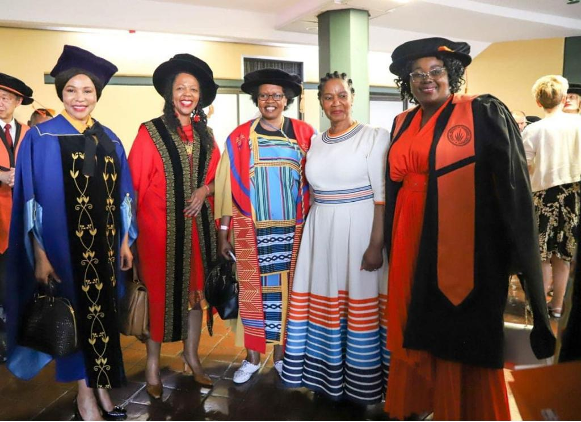
3 November 1955 – 20 November 2026

Honouring a Trailblazer, a Champion of Women’s Empowerment, and a Transformational African Leader
The Female Academic Leaders Fellowship (FALF) joins the people of South Africa, the African continent, and the global community in mourning the passing of Dr Phumzile Mlambo-Ngcuka, an extraordinary stateswoman, visionary leader, educator, and unwavering champion of gender equality and social justice.
We honour a phenomenal African woman whose life was defined by courage, conviction, intellectual leadership, and an unshakeable belief in the potential of women and girls to transform society.
Dr Mlambo-Ngcuka was more than a trailblazer. She was a pathfinder who challenged barriers, opened doors, and demonstrated through her extraordinary journey that women’s leadership is not simply a matter of representation, but a powerful catalyst for meaningful and lasting transformation.
As the first woman to serve as Deputy President of the Republic of South Africa, she shattered one of the country’s highest political glass ceilings. As the former United Nations Under-Secretary-General and Executive Director of UN Women, she carried the aspirations of women and girls onto the global stage, advocating for equal opportunities, economic empowerment, education, dignity, and freedom from violence and discrimination.
Dr Phumzile Mlambo-Ngcuka firmly believed that the advancement and empowerment of women could never be the responsibility of women alone but required the collective commitment and action of both women and men. This conviction found powerful expression in HeForShe, the global solidarity movement for gender equality launched by UN Women under her leadership. Through this initiative, she challenged men and boys to become active partners, advocates, and agents of change in dismantling patriarchal structures, confronting gender-based discrimination, and creating a more just and equitable society. She understood that gender equality is not a women’s issue, but a shared human responsibility that demands courage, accountability, and transformative leadership from everyone. Her vision of collective action reminds us that genuine empowerment is achieved not by women struggling in isolation, but through solidarity, shared responsibility, and the active participation of men and women working together to transform institutions, communities, and societies. For FALF, this enduring message reinforces our belief that advancing women in academic leadership requires the commitment of the entire higher education community, including men who are willing to champion gender equality, challenge systemic barriers, and become intentional partners in transformation.
Her legacy extends far beyond the distinguished positions she occupied. Her true contribution lies in the lives she touched, the opportunities she helped create, and the generations of women she inspired to believe that their voices, intellect, leadership, and ambitions mattered.
We at FALF will also remember Dr Mlambo-Ngcuka with particular affection and gratitude for her contribution to our journey. Her participation as keynote speaker at our inaugural Research Symposium in 2022 was a powerful affirmation of our vision and the importance of women’s leadership in research and higher education. Her engagement with our mission strengthened the conviction that African women must not only participate in knowledge production but also lead in shaping the institutions, ideas, and solutions that will define our continent’s future.
For FALF, Dr Mlambo-Ngcuka’s life and work resonate profoundly with our mission to advance women in academic leadership, transform institutions of higher learning, and create pathways for African women to thrive as scholars, researchers, innovators, and leaders.
She understood that education is both an instrument of personal empowerment and a foundation for societal transformation. She recognised that investing in women’s education and leadership is not merely an investment in individuals, but in families, institutions, communities, nations, and future generations. In her own words, ‘transformation is about solving for the ones furthest left behind first’.
Her lifelong commitment to education, including her work through the Umlambo Foundation and her leadership as Chancellor of the University of Johannesburg, reflected her conviction that access to knowledge and opportunity must translate into genuine empowerment.
At the heart of her leadership was a principle that FALF holds dear: when women rise, they must create opportunities for others to rise with them.
Her example reminds us that transformation cannot be measured solely by the number of women who reach positions of influence. It must also be measured by the barriers they dismantle, the institutions they reshape, and the opportunities they create for those who follow.
In Dr Mlambo-Ngcuka, we saw a leader who connected intellectual excellence with social responsibility, local action with global impact, and personal achievement with collective progress.
She embodied the kind of leadership that FALF strives to nurture: leadership grounded in integrity, courage, collaboration, service, and an enduring commitment to equity and inclusion.
As we reflect on her passing, we are reminded that the struggle for gender equality remains unfinished. Women, particularly African women, continue to face structural barriers in academia, research, executive leadership, and other spheres of influence. The most meaningful tribute we can pay to Dr Mlambo-Ngcuka is to continue challenging these inequalities with the same determination that characterised her life’s work.
We must continue to build institutions where women’s brilliance is recognised, where their leadership is valued, where their contributions shape knowledge and policy, and where the next generation of women can aspire without limitation.
Her passing leaves an immeasurable void, but her legacy is enduring. It lives in every young girl and every African child who dares to dream beyond the boundaries imposed upon her. It lives in every woman who claims her rightful place at the
leadership table. It lives in every institution that chooses transformation over exclusion and in every leader who understands that true progress is collective.
On behalf of the FALF Board, leadership, Fellows, alumnae, SA University Chancellors Forum and broader community, we extend our heartfelt condolences to the Mlambo and Ngcuka families, the UJ Community, her loved ones, colleagues, and all who were privileged to know and work alongside her.
We honour her extraordinary contribution to South Africa, to Africa, and to the world. We celebrate her intellect, her courage, her humanity, and her steadfast belief in the transformative power of women.
May we honour her not only through our words, but through our actions. May every woman we empower, every barrier we break, and every opportunity we create become part of her continuing legacy.
Rest In Eternal Peace, Dr Phumzile Mlambo-Ngcuka.
You have walked a remarkable journey, broken barriers, and illuminated pathways for generations of women who will follow.
Your voice may be silent, but your legacy will continue to speak through the women and men that you inspired and the futures you helped make possible.
Ndlelanhle, Big Sis, Mdineka! Sishange! Mlambo omkhulu ongawelwa muntu!. Your legacy lives on.
Issued by the Female Academic Leaders Fellowship (FALF)
21 November 2026
